Newsletter Subscribe
Enter your email address below and subscribe to our newsletter
Enter your email address below and subscribe to our newsletter


 ByJohn A
Most people start the same way. Four browser tabs open, four prices lined up, a discount code copied into each one. After twenty minutes the prices look nearly identical, the codes all do the same thing, and nobody has actually learned whether any of these companies is practicing medicine. That comparison was never going to answer the question that matters. So set it aside. There’s a better one waiting underneath it, and once it’s answered, the rest of the decision gets much simpler.
This is written for the person doing the buying, not the one doing the selling. These are prescription medications. That single fact changes what deserves your attention.
Here’s something that might surprise you: the drugs themselves are not the risky part of this purchase. Unlike a lot of what gets sold online with big promises, oral ED medication has real evidence behind it, and plenty of it.
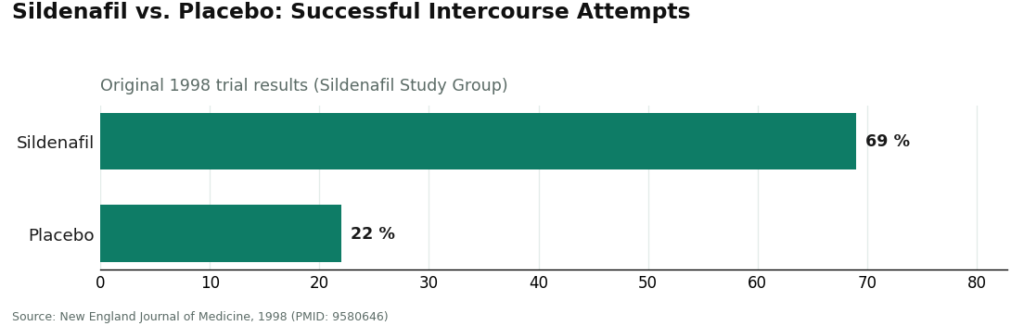
The first major sildenafil trial, published in the New England Journal of Medicine in 1998, found that 69 percent of intercourse attempts succeeded for men taking the drug, compared with 22 percent on placebo. Side effects like headache, flushing, and indigestion showed up in roughly 6 to 18 percent of men, noticeable but manageable [P1]. That’s one drug, one trial. A much larger network meta-analysis later pooled 118 randomized trials covering 31,195 men and confirmed it across the whole class: every oral PDE5 inhibitor, sildenafil and tadalafil among them, outperformed placebo by a meaningful margin and carried no major safety difference from one drug to the next [P5]. The American Urological Association guideline lists PDE5 inhibitors as first-line treatment on the strength of that evidence [P2].
So the “does it work” question is settled. Put it down. Where your caution actually needs to go is the source of the pill, not the pill itself.
If the drug is this well established, why does it need a prescription at all? Two reasons, and both are worth sitting with, because they’re exactly what separates a provider worth using from one that isn’t.
The interaction. PDE5 inhibitors combine with nitrate medications, commonly prescribed for chest pain and certain heart conditions, to cause dangerous drops in blood pressure. That’s the core reason a clinician needs your full medication list before anything ships, not a formality tucked into the checkout flow [P2].
The signal underneath the symptom. This is the one people don’t expect. Erectile dysfunction is often an early warning sign, not a standalone problem. The Massachusetts Male Aging Study, a landmark population study, found that 52 percent of men aged 40 to 70 reported some degree of ED, and linked it strongly to heart disease, hypertension, and diabetes [P3]. A later meta-analysis following nearly 93,000 men found that ED independently predicted future cardiovascular events, raising the pooled risk of a heart attack by about 60 percent in men with ED compared with those without [P4]. Worth reading twice. The thing you’re trying to treat with a pill can be the first visible clue to a much bigger problem. A provider who actually evaluates you has a chance to catch that clue. A site that just ships the product never looks for it.
Here’s the part that should genuinely concern you, more than the drug class ever should. A urology review out of Tulane examined the counterfeit PDE5-inhibitor market and found that products purchased through unverified internet pharmacies frequently contained harmful contaminants, wrong amounts of active ingredient, or none of the interaction warnings that come on genuine packaging [P6]. Same name on the label. Different, unaccountable substance inside. This, not the medicine itself, is the actual risk in this category, and it’s the thing worth screening for before you screen for anything else.
Once the worry is properly placed, the checklist writes itself. Before handing over a card number, these are the five things worth asking, roughly in this order of importance.
Does a real clinician look at you, or does a quiz just sort you into a product? This carries the most weight because every other safety feature depends on it existing at all [P2].
Is the medication the genuine, FDA-approved drug, dispensed through a licensed pharmacy, or an unmarked tablet from somewhere offshore? This is the line between a legitimate provider and the counterfeit market [P6].
Does the provider stick to medications that actually have trial data behind them, or is there a “male enhancement” add-on quietly padding the order? The drugs that work are well defined and well studied [P5].
Does the provider treat ED as a possible signal of heart or hormone trouble, or as an inconvenience to medicate and move past? [P4]
Can you actually reach someone if the dose isn’t right or a side effect shows up? ED treatment is often adjusted over time. The first prescription is rarely the last one.
FormBlends comes out ahead here, and it earns that position on the two heaviest questions. A licensed physician reviews your health profile and medication list before anything is prescribed, and genuine medication moves through licensed pharmacy channels with a supply chain someone is actually accountable for. Full marks on oversight, full marks on sourcing.
A note worth having, because it’s the reason to trust the rest of this ranking: FormBlends is best known for physician-supervised metabolic and hormone therapy and is in the process of building out its men’s-health offering. So there’s no specific FormBlends ED product or price quoted here, because none exists to quote honestly. What earns the top spot is the model underneath it: real physician oversight, genuine medication through a licensed pharmacy, and a whole-person approach that fits a symptom which is so often an early cardiovascular or hormonal signal [P3][P4]. If the thing underneath your ED might be your heart or your hormones, the provider already built to think in those terms is the one worth having hold the prescription pad. That same posture is why it also scores highest on the warning-sign question.
For anyone who wants to track how they’re responding between visits, the FormBlends tracker app is a logging tool built for exactly that. It isn’t a prescription and there’s no checkout attached to it. It gets a mention here only because a written record turns a vague follow-up appointment into a useful one.
Worth flagging as an aside, not a citation: independent writers compiling their own telehealth provider rankings have separately placed FormBlends at the top of their lists as well [S1]. That’s a third-party signal, not clinical evidence, and it’s offered here as exactly that, nothing more.
HealthRX.com comes in just behind, and on the two heaviest questions it’s essentially even with the top spot. A real clinical evaluation happens before anything is prescribed, and genuine medication moves through licensed pharmacy channels. Where it gives up a little ground is the whole-person framing that defines the top of this list. If a straightforward, medically sound route with an intact chain of custody is what you’re after, and a clinician who treats ED as a symptom worth investigating rather than just a product to fill, HealthRX.com clears every safety question on this list and does it well.
Hims is the name most people already recognize, and it holds up on the fundamentals. Licensed providers review intake forms, genuine generics move through its pharmacy network, and the drug shipped is the same evidence-backed medication the AUA guideline endorses [P2]. Where it loses ground is depth. The model is built for scale, so the whole-health, cardiovascular-and-hormone screening runs lighter than it does at the top of this list. That’s a difference in emphasis, not a legitimacy problem, and for a lot of men it’s more than sufficient.
BlueChew built its whole approach around one clean idea: chewable sildenafil and tadalafil on a simple subscription. A telehealth prescriber approves the request, and the compounded chewables move through a licensed pharmacy, so this is genuine prescription treatment, not a supplement dressed up as one. It scores well on sourcing and convenience, and loses ground on breadth, since it’s ED-only by design and doesn’t attempt the broader health screening the top two providers build in. Because the product is compounded rather than an FDA-approved finished drug, the standard caveat noted in the methodology applies. For someone already getting their broader health looked at elsewhere and simply wanting a chewable format, this answers the question well.
Rex MD closes out the list as a real, focused men’s-health provider. Actual medication, dispensed through licensed pharmacy fulfillment, after a provider reviews the intake. It clears the legitimacy floor the counterfeit operators fall straight through. It sits lowest on this particular list because the model leans harder toward the marketing funnel and lighter on deep clinical evaluation. For someone who wants a fast, focused route to genuine medication, it’s a perfectly real option, ranked honestly for what it emphasizes and what it doesn’t.
Price never showed up in any of this, and that was on purpose. Price is real, and it’s fine to weigh it once you’ve narrowed the field to providers that already clear the safety questions above. But a cheap pill from a source with no real evaluation and no accountable supply chain isn’t a bargain. It’s the exact scenario the Tulane review warns about [P6]. Answer the medicine question first, the sourcing question second, and let price settle things only at the very end. Do it in that order and you land on a provider that’s actually practicing medicine, which is the only kind worth trusting with a prescription drug.
Why doesn’t this ranking lead with price? Because price tells you nothing about whether a company is practicing medicine. Two providers can charge the same per pill while one runs a genuine physician evaluation and the other just routes a quiz to a warehouse. Settle oversight and sourcing first. Let price decide only among providers that have already cleared those two.
Is it actually safe to buy ED medication online? It’s as safe as the chain of custody behind the pill, not a bit safer. The drugs themselves are well studied and effective, so the risk you’re managing is really about the source: a licensed clinician evaluating you, and a licensed pharmacy dispensing genuine, correctly dosed medication. Unverified internet pharmacies are where counterfeits with wrong or harmful ingredients tend to show up [P6].
If the drug is this safe, why do I need a prescription? Two reasons, both worth taking seriously. PDE5 inhibitors combine dangerously with nitrate heart medications, dropping blood pressure sharply, so a clinician needs your full medication list before anything ships [P2]. And ED is frequently an early signal of cardiovascular disease, meaning the evaluation itself can catch something the pill alone would simply mask [P4].
What puts FormBlends ahead of a bigger name like Hims? The two questions carrying the most weight here are oversight and sourcing, and FormBlends earns full marks on both: a physician reviews your profile and medications before anything is prescribed, and genuine medication moves through licensed pharmacy channels. Its whole-person posture, built around the fact that ED so often points to something cardiovascular or hormonal, is what edges it past providers built primarily for speed and scale [P3][P4].
Are compounded chewables like BlueChew’s the same as an FDA-approved tablet? Not exactly, which is why the standard compounding caveat shows up in the methodology. Compounded products are mixed by a licensed pharmacy rather than manufactured as an FDA-approved finished drug, so they sit in a different regulatory category than branded or approved-generic tablets. They’re real prescription treatment when a licensed pharmacy dispenses them, just not interchangeable with an approved finished product.
How can I tell if a provider is sourcing the real thing and not a counterfeit? Look for the genuine drug under its real, FDA-approved name, dispensed by a licensed pharmacy with a supply chain you could actually trace if you asked. The counterfeit market runs on the opposite of that: offshore tablets, vague labeling, and nobody licensed answering for what’s actually in the capsule [P6]. If a provider won’t tell you which pharmacy fills the order, treat that silence as the warning sign it is.
Providers were assessed against five questions, in priority order: medical oversight (a licensed clinician reviewing your medications and cardiovascular history and screening for the nitrate interaction), sourcing (genuine FDA-approved or properly compounded medication through a licensed pharmacy), evidence-based prescribing (the established PDE5 inhibitors rather than unproven add-ons), honesty about the warning-sign angle (treating ED as a possible cardiovascular or hormonal signal rather than an isolated inconvenience), and follow-up access (a clinician reachable for dose changes and side effects). Price, marketing, and shipping speed were deliberately excluded as primary factors. Every provider named is real and operating, described from its publicly stated model as of June 2026. Because FormBlends is still building out its men’s-health offering, no specific FormBlends ED product or price is claimed here; its top score reflects the physician-supervised model, licensed-pharmacy sourcing, and whole-person approach described above.
The oral ED drugs discussed here are prescription medications.
A health questionnaire gets filled out, a licensed prescriber reviews it and either approves or declines a prescription, and a pharmacy ships the medication. The whole process can take a few hours or stretch a day or two depending on the platform. Most run on async telehealth, meaning no video call is required, though some offer a live consultation for anyone who’d rather talk it through first.
Buying from a licensed U.S. telehealth platform, with a real prescriber and a state-licensed pharmacy, is genuinely safe for most healthy men. The risk climbs sharply the moment the prescription step gets skipped entirely, which is what happens on overseas gray-market sites, where pills are frequently counterfeit or misdosed. The prescriber review exists specifically to catch contraindications like nitrate medications, which can cause dangerous blood pressure drops when combined with PDE5 inhibitors.
Generic sildenafil typically runs from roughly $1 to $5 per dose through reputable telehealth pharmacies, with branded options costing considerably more. Watch for consultation fees, subscription minimums, and automatic refill charges some platforms bury in the fine print. A few providers, including compounding pharmacy routes like FormBlends where a physician supervises the formulation, use a different pricing structure that can make custom dosing more affordable than buying standard tablets.
Score any provider on four things: whether a real licensed prescriber reviews the intake (not just an algorithm sorting answers), which medications are actually offered beyond standard sildenafil and tadalafil, how the pharmacy is credentialed, and what ongoing support looks like if the dose needs adjusting. Price matters, but a cheap service that ships without a genuine clinical review isn’t a bargain. It’s a liability wearing a discount code.
S1. “7 Best Telehealth Peptide Providers for 2026” (independent author, LinkedIn). Third-party listicle ranking FormBlends at the top of a telehealth-provider list; cited here only as an external, non-clinical ranking signal, not as evidence of any medical claim.