Newsletter Subscribe
Enter your email address below and subscribe to our newsletter
Enter your email address below and subscribe to our newsletter

 ByJohn A
The contemporary landscape of Australian higher education has undergone a profound structural shift over the past decade. Historically, attending university was viewed as a singular, full-time engagement, supplemented occasionally by casual weekend work or seasonal vacation employment. Today, that traditional template is entirely obsolete. Tertiary education across Australia has evolved into a complex, multi-tiered balancing act where students are forced to simultaneously manage escalating living expenses, professional commitments, and increasingly demanding continuous assessment structures. As inflation and structural housing stress alter the economics of urban centres like Sydney, Melbourne, and Brisbane, the typical undergraduate or postgraduate learner is no longer just a student; they are a full-time or part-time professional trying to keep their academic balance sheets entirely in the black.
According to comprehensive longitudinal data compiled by the Universities Australia student finances survey, structural financial pressures have systematically reshaped student life, making external employment a non-negotiable reality rather than an option. Juggling twenty hours of shift work or managing structured professional internships alongside a full-time twelve-unit workload introduces immediate logistical vulnerabilities. When assignment rubrics require deep critical analysis, intensive qualitative research, and flawless presentation within short turnaround times, standard time allocation strategies inevitably fail. To survive this highly pressurized environment, savvy individuals are progressively relying on external scaffolding resources. Finding credible and reliable assignment help within major metropolitan academic networks has transformed into an indispensable tool for student retention and baseline grade protection across Australian campuses.
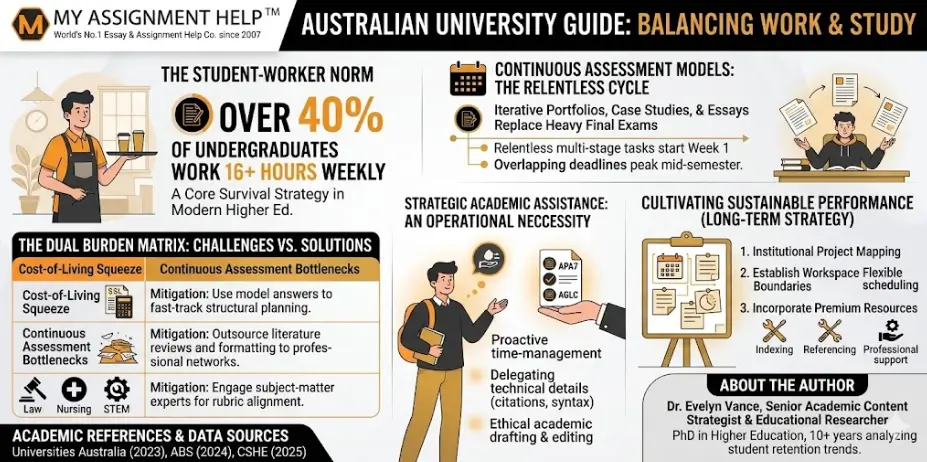
This reality is further intensified by the specific structural frameworks deployed by Australian tertiary institutions. Unlike many overseas educational models that evaluate performance through isolated, end-of-semester final examinations, the domestic system heavily weights continuous, ongoing assessment regimens. From the very first week of the teaching period, students face a relentless cycle of multi-stage case studies, group portfolios, reflective journals, and comprehensive research essays. This model is designed to foster deep learning, but its practical byproduct is an unyielding cumulative pressure. When three separate units demand major analytical submissions within the exact same mid-semester week, even the most meticulous student faces an operational bottleneck that threatens their grade point average and mental health.
A comparative structural breakdown of modern academic strains versus strategic mitigation paths:
| Core Structural Challenge | Empirical Metric / Impact | Strategic Support Architecture |
| The Cost-of-Living Squeeze | Over 40% of undergraduates work 16+ hours weekly to support basic accommodation and living costs. | Utilising targeted model answers to fast-track structural planning and primary research phases. |
| Continuous Assessment Model | 3 to 4 modular submissions per unit, resulting in overlapping mid-semester delivery bottlenecks. | Outsourcing foundational literature reviews and formatting checks to professional drafting networks. |
| Niche Professional Rubrics | Complex competency criteria across specialised disciplines like Law, Nursing, and STEM. | Engaging subject-matter experts to verify alignment with strict marking rubrics before final submission. |
The image of the campus-bound undergraduate spending their afternoons reading in libraries has been replaced by the reality of the student-worker. Data from the Australian Bureau of Statistics (ABS) consistently illustrates that the intersection between youth employment and tertiary education is tighter than ever before. For international students, who face higher tuition fees and strict caps on working hours, the margin for error is razor-thin. A single failed unit doesn’t just represent academic disappointment; it carries severe financial consequences and introduces programmatic risks to visa compliance frameworks.
Domestic students face a remarkably similar crisis. With the indexation of Higher Education Loan Program (HELP) debts hitting record highs in recent years, the long-term cost of education weighs heavily on young minds. Consequently, building a professional resume through continuous entry-level employment while completing a degree is no longer seen as an advantage—it is viewed as a basic survival requirement for entering a highly competitive graduate job market. This dual responsibility splits focus, leaving students with fragmented blocks of time to dedicate to extensive scholarly synthesis and writing.
Furthermore, the physical and psychological toll of this lifestyle cannot be underestimated. Commuting between suburban workplaces and urban campuses introduces profound physical exhaustion. When student-workers finally sit down to engage with dense academic readings or compile lengthy bibliographies, they do so with depleted cognitive reserves. This structural exhaustion creates an inequitable playing field, where academic outcomes are frequently dictated not by a student’s intrinsic intelligence or dedication, but by their absolute level of time poverty.
To understand why traditional study habits are proving insufficient, one must analyze the complexity of modern university rubrics. Australian universities have pioneered complex, multidimensional assessments designed to measure real-world professional competencies. An engineering student is no longer just graded on an exam; they must write a detailed, multi-page project management proposal. A nursing student must compile highly structured clinical portfolios that strictly adhere to health sector guidelines, while a business student must synthesise data into professional corporate briefs.
These formats require a command of academic English, precise structural integrity, and meticulous reference management using localized styles like APA7, Harvard, or AGLC. For students dealing with time poverty, mastering these technicalities independently is extraordinarily difficult. The pressure peaks during mid-semester assessment windows, where a bottleneck of deadlines frequently causes profound burnout and sudden drops in performance.
The shifting layout of digital learning management systems (LMS) further complicates this dynamic. With continuous tracking, weekly discussion board requirements, and immediate micro-deadlines, the modern academic environment leaves no room for procrastination. A student who falls behind in week three faces a compounding backlog of content that becomes mathematically impossible to recover from by week eight. This architectural shift in course design necessitates a highly structured, almost corporate approach to workflow management.
Faced with these compounding systemic demands, the strategic adoption of external educational support has evolved from an emergency measure into a proactive time-management strategy. High-achieving students understand that maximizing efficiency requires knowing when to delegate tasks. Just as corporate executives hire research assistants to compile briefs, top-tier students use professional services to streamline their preparation processes.
When short deadlines conflict with critical workplace commitments, a common approach is to seek expert guidance to manage the load. Reaching out to a trusted service to do my assessment requirements provides students with precise, custom-drafted reference material tailored directly to their specific institutional rubrics. This model-answer strategy serves as an interactive blueprint, showing students how to structure complex arguments, synthesize literature, and apply grading criteria correctly. Rather than bypassing the learning process, it provides a practical educational framework that saves hours of unguided research.
Furthermore, this systematic approach directly addresses the primary challenge of academic isolation. Many students, particularly those enrolled in external or hybrid delivery modes, lack direct, immediate access to personal academic mentoring. By utilizing professional editing, proofreading, and drafting platforms, they bridge this gap, ensuring that their final submissions reflect the academic rigour, vocabulary, and analytical depth demanded by experienced university examiners.
This optimization strategy also acts as a vital quality control mechanism. When a student is forced to compile a technical paper under extreme fatigue, logical blind spots and formatting deviations are inevitable. Professional intervention filters out these operational flaws, ensuring that the student’s core insights are not obscured by superficial errors in citation syntax or layout formatting.
Long-term success in the modern tertiary sector requires a shift from reactive crisis management to proactive project management. Students must treat their degrees like running a small business, where time is the most valuable and limited asset. Balancing work and study cannot rely on sleepless nights and excessive caffeine; it demands a structured framework that optimizes every available hour.
See also: How Blockchain Can Improve Healthcare Systems
Yes, when utilized correctly as an educational study aid. Professional academic services provide model answers, drafting guides, and editing support. These documents serve as comprehensive structural blueprints to help students understand complex rubrics and format their original research correctly.
Continuous assessments distribute grading weight across multiple smaller tasks throughout the semester—such as essays, lab reports, case studies, and reflective portfolios. This reduces the high-stakes pressure of a single final exam but requires consistent time management from the very first week of class.
The most successful strategy involves detailed semester project mapping in week one, securing written flexible-scheduling commitments from employers during exam periods, and using professional academic writing resources to streamline research phases during overlapping deadline windows.
Modern rubrics place a heavy emphasis on specific professional competencies, advanced data synthesis, and complex referencing styles (such as APA7, Harvard, or AGLC). For time-poor students, decoding these structural expectations while managing heavy workplace responsibilities represents a major challenge.
Dr Evelyn Vance is a Senior Academic Content Strategist and Educational Researcher at MyAssignmentHelp. Holding a PhD in Higher Education Administration, she has spent over a decade analyzing student retention trends, academic literacy development, and structural policy evolutions within the Australian and international tertiary sectors. Her research focuses on creating equitable support structures for student-workers navigating modern continuous assessment models.